
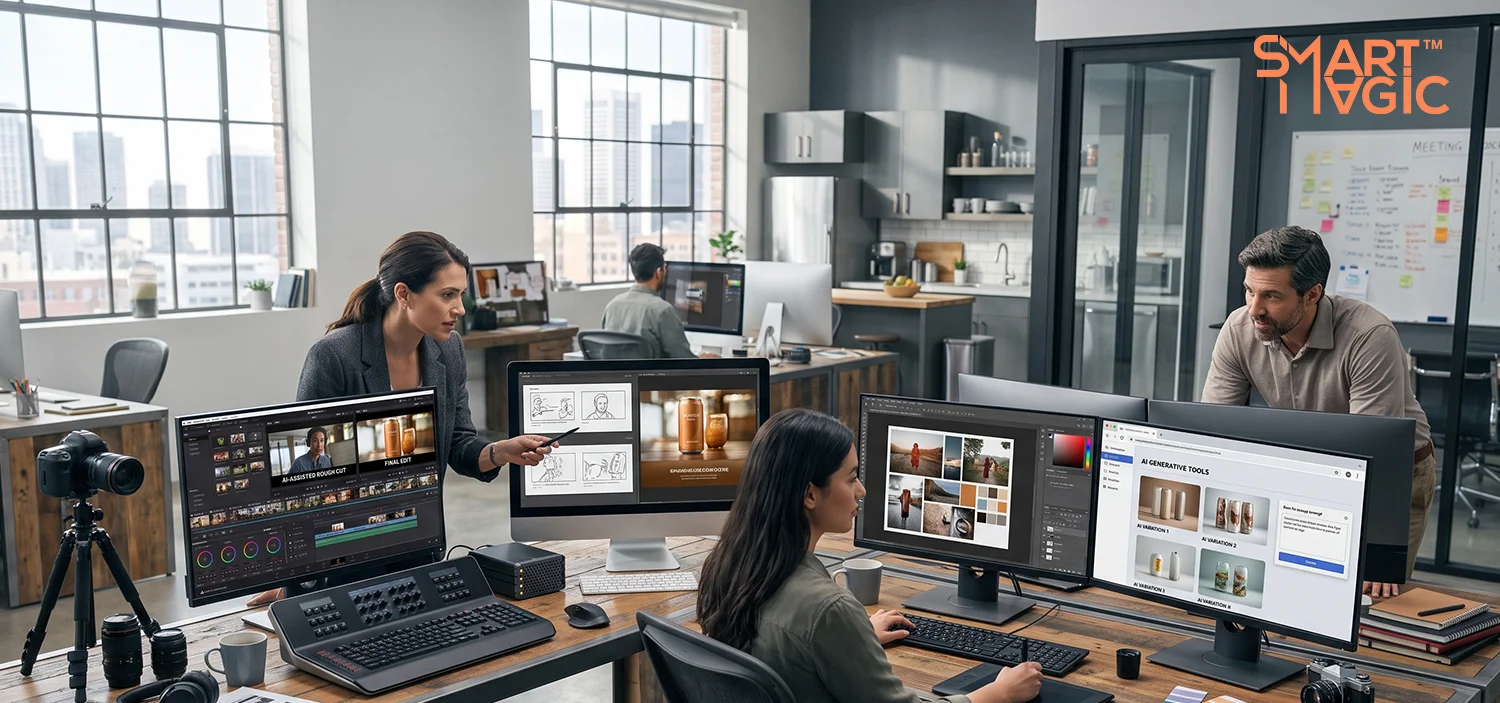
Advertising has always been about ideas.
The technology behind those ideas has changed many times. From film cameras to digital cameras, from television commercials to social media videos, every new technology has changed how creative teams produce and distribute content.
Now, artificial intelligence is bringing another major shift.
But AI is not simply replacing cameras, editors, writers or designers. Instead, it is changing the creative workflow itself. Tasks that once took hours can now take minutes. Teams can explore more ideas before choosing one. Brands can create multiple versions of the same campaign without starting from scratch.
This is where the real impact of AI in ad production can be seen.
The modern advertising workflow is becoming faster, more flexible and more collaborative. AI is becoming part of almost every stage, while human creativity remains responsible for the decisions that actually make an advertisement worth watching.
What Has Changed in Ad Production?
Traditional ad production usually follows a familiar process.
A client shares a brief. The creative team develops an idea. The script is written. Storyboards are created. Locations, actors, equipment and crew are arranged. The shoot takes place. Then the footage goes into editing, followed by colour correction, sound design, graphics and multiple rounds of revisions.
It is an effective process, but it can also be time-consuming.
A small change to the concept can affect the script, shoot plan and production budget. Creating different versions of an advertisement for different audiences can require additional shoots or extensive post-production.
AI is changing this equation.
Instead of using AI at one specific point, creative teams can now use it throughout the production pipeline. It can assist with research in the morning, help develop concepts in the afternoon and support editing or versioning later in the process.
The workflow is becoming less linear.
AI Starts Before the Camera Rolls
One of the biggest changes is happening before production even begins.
Creative teams spend considerable time understanding a brief. They need to identify the audience, understand the product, research competitors and find the right communication angle.
AI can help accelerate this preparation.
A creative team can use AI to organise research, analyse large amounts of information and identify patterns in audience behaviour. It can also help generate different creative territories based on a campaign objective.
This does not mean asking AI to simply “write an advertisement.”
The better approach is to use AI as a creative thinking partner.
For example, if a brand wants to advertise a new financial product to young professionals, AI can help a team explore different consumer concerns, communication angles and campaign territories.
The creative team then decides which direction actually feels relevant.
That distinction is important.
AI can generate possibilities. Humans decide which possibilities are worth pursuing.
From Brief to Idea: Faster Creative Exploration
Coming up with the first idea is rarely the hardest part.
The challenge is finding the right idea.
A creative team may develop ten possible directions before discovering one that truly works. Traditionally, exploring these directions can take several meetings and multiple rounds of presentations.
AI can make this process much faster.
Creative teams can use AI to generate alternative concepts, campaign hooks, taglines, visual references and story structures. Instead of spending hours developing every possibility manually, they can quickly create a larger creative playground.
This allows teams to experiment.
An idea can be tested from different perspectives. A serious concept can be made humorous. A product-focused idea can be converted into an emotional story. A long-form campaign can be broken down into short-form social content.
The objective is not to accept the first AI-generated answer.
The objective is to reach a better human idea faster.
AI and Scriptwriting
Scriptwriting is another area where AI can become a useful part of the workflow.
A creative director or copywriter can use AI to develop rough structures, alternative openings, dialogue options and different versions of a script.
For example, a 60-second advertisement may need to communicate a product benefit within the first five seconds.
AI can help generate multiple opening hooks quickly.
The writer can then evaluate them based on brand personality, audience relevance and emotional impact.
This makes the process more iterative.
Instead of spending an entire day rewriting the same opening line, a creative team can explore several directions and then spend its time refining the strongest one.
But there is a limitation.
AI can produce technically correct writing without producing something memorable.
Human writers understand cultural nuances, humour, emotion and context in ways that cannot simply be reduced to prompts. A line may look perfect on paper but sound completely unnatural when spoken by a real person.
That is why human judgement remains essential.
Storyboards and Pre-Visualisation Are Becoming Easier
One of the biggest advantages of AI for production teams is visualisation.
Before shooting an advertisement, directors often need to explain how a scene will look. Traditionally, this could involve sketches, mood boards, reference images or detailed storyboards.
AI-powered visual tools can help teams create visual references much faster.
A director can explore different locations, compositions, lighting styles or visual moods before the shoot begins.
This can improve communication between the director, cinematographer, production designer and client.
Everyone can have a clearer understanding of the intended visual direction.
It can also prevent expensive mistakes.
If a particular visual approach does not work during pre-production, it is far cheaper to discover that before the camera starts rolling.
The Shoot Still Matters
With all the discussion around AI-generated video, it is easy to assume that traditional production is disappearing.
That is not necessarily the case.
For many advertisements, real people, real locations and real performances remain incredibly valuable.
There is something about a genuine human expression, physical environment or imperfect moment that can make an advertisement feel authentic.
AI can support production, but it does not automatically replace the need for a good director, cinematographer, actor or production crew.
Instead, the production process can become more informed.
The team arrives on set with clearer references, better-prepared concepts and a stronger understanding of what needs to be captured.
AI can help reduce uncertainty before production.
The camera still captures the story.
AI Is Transforming Post-Production
Post-production is perhaps where AI is already having one of its most practical impacts.
Editors can use AI-assisted tools for tasks such as transcription, subtitles, scene detection, noise reduction, object removal, audio enhancement and rough assembly.
Consider a podcast or interview shoot with several hours of footage.
Instead of manually reviewing every minute, AI can help transcribe the conversation and identify relevant sections. Editors can then find important moments faster.
This does not eliminate editing.
It changes where the editor spends their time.
Rather than spending hours on repetitive tasks, the editor can focus more on pacing, storytelling, music, visual rhythm and emotional impact.
That is a significant shift.
The editor becomes less of a technician handling every individual task and more of a creative decision-maker.
One Shoot, Many Advertisements
Modern advertising is no longer about creating one television commercial and distributing it everywhere.
A single campaign may need a 60-second film, a 30-second cut, multiple Reels, YouTube versions, Stories, display assets and different edits for different audiences.
This creates enormous production pressure.
AI can help brands adapt existing creative assets into multiple formats.
A long-form advertisement can be transformed into shorter versions. Transcripts can become social captions. Footage can be reframed for vertical platforms. Subtitles can be generated automatically.
This is where AI becomes particularly valuable for social-first advertising.
The creative idea remains the same, but the execution can change depending on where the audience sees it.
Personalisation at Scale
Another major development is personalised advertising.
Different audiences respond to different messages.
A first-time buyer may care about affordability. An existing customer may care about an upgrade. A younger audience may respond to a different tone than an older audience.
Traditionally, creating separate advertisements for each group would increase production costs significantly.
AI can make this process more scalable.
A brand can create variations in copy, visuals, voiceovers, subtitles or offers while maintaining the core campaign identity.
This does not mean creating thousands of completely different advertisements.
It means creating a flexible creative system.
The campaign becomes a collection of adaptable assets rather than one fixed video.
AI Makes Testing More Important
When creating advertisements becomes faster, testing becomes even more important.
Instead of arguing about which headline or opening shot might perform better, creative teams can produce multiple variations and measure their performance.
For example, one version may open with a question.
Another may open with a surprising statistic.
A third may start with an emotional moment.
The audience response can help determine which direction deserves more attention.
This creates a more experimental approach to advertising.
Creativity and performance marketing begin working more closely together.
The creative process becomes a cycle:
Create. Test. Learn. Improve. Repeat.
The New Creative Team
AI is also changing what modern creative teams look like.
A production team may increasingly include people who understand both traditional creative skills and AI tools.
A copywriter may use AI for research and ideation.
An editor may use AI-assisted post-production tools.
A designer may use generative tools for early visual exploration.
A producer may use AI to organise information and streamline workflows.
But the most valuable skill remains the ability to make good creative decisions.
Knowing how to use a tool is useful.
Knowing when not to use it can be even more valuable.
What AI Cannot Replace
Advertising is ultimately about people.
People have to recognise themselves in a story. They have to feel something. They have to believe a character. They have to understand why a product matters to them.
AI can help generate an image.
It cannot automatically understand whether that image has emotional meaning for the audience.
It can suggest a tagline.
It cannot guarantee that people will remember it.
It can create a video.
It cannot automatically give that video a point of view.
That still comes from human creativity.
The strongest advertising workflows will therefore not be “AI versus humans.”
They will be AI plus humans.
The Future of Ad Production Is Hybrid
The most practical future of advertising is likely to be a hybrid one.
Real production will continue to matter. Directors, writers, actors, cinematographers, editors and designers will continue to shape campaigns.
At the same time, AI will increasingly handle repetitive work, accelerate experimentation and make creative production more scalable.
The result could be a very different production process.
Campaigns can move from idea to execution faster. More concepts can be explored. More variations can be tested. More content can be created from the same core assets.
But speed should never become the only goal.
The purpose of technology is not to make advertisements faster for the sake of being faster.
It is to give creative teams more time to focus on what actually matters: the idea, the story and the audience.
AI Is Changing the Workflow, Not the Need for Creativity
The advertising industry has always adapted to new technology.
AI is simply the next major shift.
The biggest opportunity is not in asking AI to do everything. It is in identifying the parts of the creative process where AI can remove unnecessary friction.
Research can become faster.
Ideation can become broader.
Pre-production can become clearer.
Post-production can become more efficient.
Content versioning can become easier.
Testing can become more systematic.
But the central creative question remains the same:
What do we want people to feel, think or do after they see this advertisement?
That question still needs a human answer.
The new creative workflow is therefore not about handing the entire production process to AI. It is about building a smarter partnership between technology and creative talent.
And for brands, agencies and production companies, that may be the real advantage of AI: not replacing creativity, but giving creativity more room to work.
Final Thought
The future of ad production will not belong to the teams that simply use the most AI tools.
It will belong to the teams that know how to combine those tools with strong ideas, human insight and great storytelling.
AI can make the workflow faster.
Creativity still makes the advertisement worth watching.
Read More: Hyper-Personalised Advertising: How AI Can Create Ads for Different Audiences at Scale