
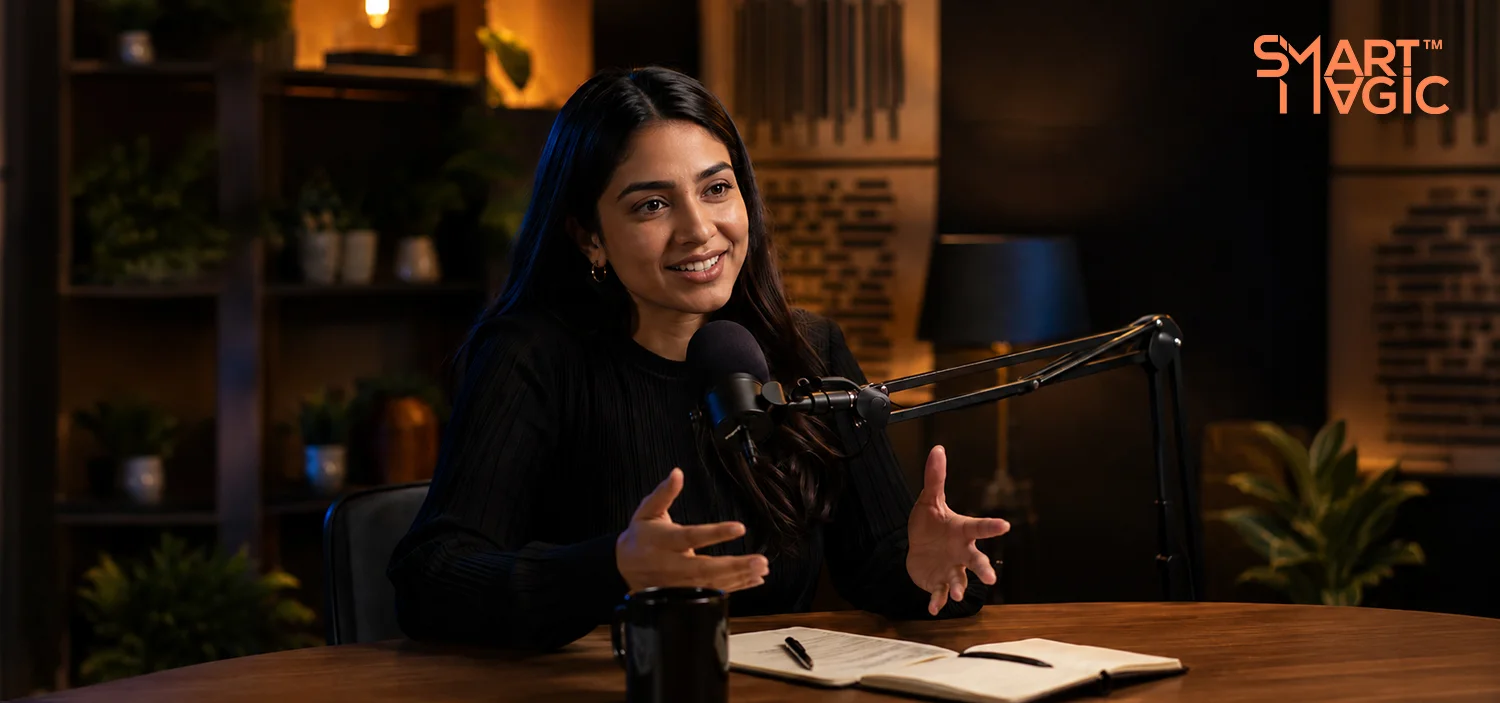
Podcasts have been around for years. But the way people consume them has changed.
Earlier, podcasts were mostly associated with audio. People would put on their headphones and listen while travelling, exercising, working or doing other things.
Today, podcasts are becoming much more visual.
People are not just listening to conversations. They are watching them.
They are watching founders talk about their businesses, experts share their experiences, celebrities tell stories and creators have long conversations with interesting guests. Platforms such as YouTube and social media have made video podcasts easier to discover and easier to share.
This has created an interesting opportunity for brands.
A video podcast is no longer just another form of content. It can become a powerful way for a brand to show its personality, share knowledge and build a stronger relationship with its audience.
And perhaps the biggest advantage is simple.
People get to see the people behind the brand.
What Is a Video Podcast?
A video podcast is essentially a podcast that is recorded on camera.
The conversation can still be available as audio, but the recording also gives viewers a visual experience.
They can see the host and guest talking. They can see their expressions and reactions. They can watch the conversation unfold rather than simply listening to voices.
This may sound like a small difference, but it changes how people connect with the content.
When you can see someone speaking, the conversation can feel more personal.
You can see their excitement when they talk about something they love. You can see their reaction when they remember a difficult experience. You can notice their expressions when they disagree with someone.
These small details make a conversation feel more real.
People Want to Know Who Is Behind a Brand
Modern consumers do not always want to interact with a faceless company.
They want to know who is behind the business.
Who started it?
Why did they start it?
What do they believe in?
What do they know?
What kind of people work there?
This is especially important for businesses where trust plays a major role.
A customer may see a company website and understand what the business sells. But that does not necessarily tell them what the people behind the company are like.
A video podcast can help fill that gap.
When a founder, expert or team member sits in front of a camera and has a genuine conversation, the audience gets to see the personality behind the business.
That can make the brand feel much more human.
Video Podcasts Help Build Trust
Trust is difficult to create with a single advertisement.
An advertisement can tell people that your company is good.
A podcast gives you the opportunity to show them.
You can talk about your industry, explain complicated topics, share experiences and answer questions that your audience may have.
Over time, people begin to recognise the host and become familiar with the brand.
They may watch several episodes without ever becoming a customer immediately.
That is completely fine.
Brand building takes time.
The goal is to become a familiar name that people remember when they eventually need the product or service you provide.
A video podcast can help create that familiarity because people are repeatedly seeing and hearing from the same people.
A Podcast Gives Your Brand a Voice
Every brand has a visual identity.
There are colours, logos, fonts, advertisements and websites.
But brands also need a voice.
What does the brand believe?
How does it speak?
What does it care about?
What kind of conversations does it want to be part of?
A podcast gives a brand a place to express these things naturally.
Instead of communicating through short advertisements all the time, a brand can have longer conversations around topics that matter to its audience.
This can help create a stronger and more recognisable personality.
For example, a technology company could use its podcast to discuss new technology, changing customer behaviour and the future of its industry.
A financial brand could have conversations about money, investing and financial planning.
A production company could speak with filmmakers, directors, actors and creators about how stories are made.
The podcast becomes an extension of the brand’s personality.
You Don’t Have to Constantly Talk About Your Product
One of the biggest mistakes brands can make with podcasts is turning every episode into a sales pitch.
A podcast does not have to constantly tell people to buy something.
In fact, it may work better when it does not.
Imagine a company that sells marketing services.
Instead of spending every episode explaining why people should hire them, the company could invite interesting marketers, founders and creative professionals to discuss advertising, branding and business.
The audience gets useful information.
They hear interesting stories.
They learn something new.
And while all of this is happening, they are also becoming familiar with the company hosting the conversation.
That is a much more natural way to build a brand.
Your Podcast Can Show Expertise Without Saying “We Are Experts”
There is a big difference between claiming that you are an expert and actually demonstrating your knowledge.
A company website can say, “We are industry experts.”
But a podcast can show that expertise through conversations.
A brand can invite knowledgeable guests, ask thoughtful questions and discuss real problems.
The audience can hear the knowledge for themselves.
This can be particularly valuable for businesses in areas where customers need a lot of trust before making a decision.
When people repeatedly see a brand discussing subjects they care about, that brand can gradually become associated with knowledge and credibility.
Video Makes the Content More Personal
Audio can be intimate, but video adds another layer.
Facial expressions, body language and reactions can completely change how a conversation feels.
A guest laughing at a story creates a different feeling when you can see the laughter.
A founder talking about a difficult period in their business becomes more powerful when you can see the emotion on their face.
A disagreement between two people can become much more engaging when viewers can see their reactions.
These moments are difficult to capture through audio alone.
Video gives the audience a sense that they are actually sitting in the room with the people having the conversation.
One Podcast Can Create Many Pieces of Content
Another major advantage of video podcasts is the amount of content you can get from one recording.
A one-hour conversation can become much more than one YouTube video.
The strongest moments can be turned into short videos for Instagram and YouTube Shorts.
A useful statement from the guest can become a social media quote.
An interesting discussion can become a carousel.
The entire conversation can become a blog.
Behind-the-scenes moments can be shared on Stories.
The guest can also share clips with their own audience.
This means a single recording can continue working for the brand for weeks.
Instead of constantly starting from zero, your content team has a large conversation that can be broken down into smaller pieces.
Video Podcasts Are Also Useful for Social Media
Social media has changed the way people discover content.
Someone may never search for your podcast directly.
But they may come across a 30-second clip while scrolling through Instagram.
They watch the clip because the opening catches their attention.
They find the guest interesting.
They then visit your profile.
From there, they may watch another clip or discover the full podcast.
This creates a journey from short-form content to long-form content.
The short video gets attention.
The full podcast builds the relationship.
This is one reason why video podcast marketing can be so effective for brands.
Guests Can Bring New Audiences
A good podcast guest does more than add value to your conversation.
They can also introduce your brand to people who already follow them.
Imagine inviting a well-known entrepreneur to your podcast.
After the episode goes live, the guest shares a clip with their audience.
People who have never heard of your company suddenly see your brand.
Some of them may watch the full episode.
Some may follow your social media page.
Some may discover your website.
The podcast has now helped your brand reach people who may have been difficult to reach through traditional advertising.
Of course, the guest does not have to be famous.
A knowledgeable professional with a small but highly relevant audience can sometimes be far more valuable than a celebrity with millions of unrelated followers.
The key is relevance.
You Can Build a Community Around the Podcast
A successful podcast can eventually become more than a content series.
It can become a community.
When people regularly watch the same host, listen to similar conversations and follow recurring guests, they begin to feel connected to the show.
They may comment on episodes.
They may suggest questions.
They may recommend guests.
They may share clips with friends.
This creates something that ordinary advertising often struggles to build.
A sense of participation.
The audience is no longer simply watching advertisements.
They are becoming part of an ongoing conversation.
AI Can Make Podcast Production Easier
Producing a video podcast still requires work.
You need cameras, microphones, lighting, recording equipment and editing.
But AI is beginning to make some parts of the process easier.
AI-powered tools can help create transcripts, identify interesting moments, generate captions and find sections that could work as short clips.
This can reduce the amount of repetitive work involved in turning a long recording into multiple pieces of content.
For example, instead of manually watching an entire one-hour episode again to find every useful section, AI can help identify possible highlights.
A human editor can then review those suggestions and decide which ones are actually worth publishing.
This combination can make the video podcast production process more efficient without removing the creative judgement of the team.
Your Studio Does Not Have to Look Like a Television Set
Another misconception is that every video podcast needs an expensive studio.
It does not.
Good lighting, clear audio, suitable cameras and a comfortable environment are more important than making the studio look unnecessarily complicated.
The setup should support the conversation rather than distract from it.
What matters most is that the viewer can hear the speakers clearly, see them comfortably and stay focused on what they are saying.
As your podcast grows, you can always improve the production quality.
The first priority should be creating conversations that people actually want to watch.
The Real Value Is Consistency
One good podcast episode can get attention.
But a series of good episodes can build a brand.
That is why consistency matters.
When people see your podcast regularly, they start becoming familiar with it.
They know who the host is.
They recognise the visual style.
They understand the kind of conversations you have.
Eventually, the podcast becomes something they expect from your brand.
You do not need to publish every day.
A consistent schedule that your team can realistically maintain is much better than publishing five episodes one month and disappearing for the next three.
What Makes a Video Podcast Successful?
A good camera is useful.
Good microphones are important.
Professional editing helps.
But none of these things can save a boring conversation.
The foundation of a good podcast is the conversation itself.
Choose guests who have something interesting to say.
Ask questions that go beyond basic introductions.
Give guests enough space to tell stories.
Do not be afraid of pauses or disagreements.
Let the conversation feel natural.
The best moments are often the ones that were not completely scripted.
That is what makes people feel like they are watching a real conversation rather than a long advertisement.
The Future of Brand Building Is Becoming More Personal
Advertising is becoming increasingly crowded.
Brands are competing for attention across websites, social media, search engines, video platforms and countless other channels.
In this environment, being seen is not enough.
People need a reason to remember you.
Video podcasts offer one way to build that connection.
They allow brands to spend more time talking with their audience instead of simply talking at them.
They give companies a face, a voice and a personality.
And because every conversation can be broken into smaller pieces, a podcast can support many parts of a brand’s content strategy at the same time.
Conclusion
A video podcast is much more than a camera pointed at two people having a conversation.
When done properly, it can become a long-term brand-building tool.
It can help a company show its expertise, introduce the people behind the business, create trust and reach new audiences through social media.
One conversation can also create weeks of content, from short videos and social posts to blogs and newsletters.
AI can make the process of producing and repurposing this content faster, but the heart of the podcast will always be the conversation.
People connect with people.
They remember stories, opinions, experiences and personalities.
That is why video podcasts have become so valuable for modern brands.
You are not just creating another piece of content. You are giving your brand a voice, a face and a place in an ongoing conversation with your audience.
Read More: Your Podcast Is More Than an Episode: How One Recording Can Become a Month of Content