
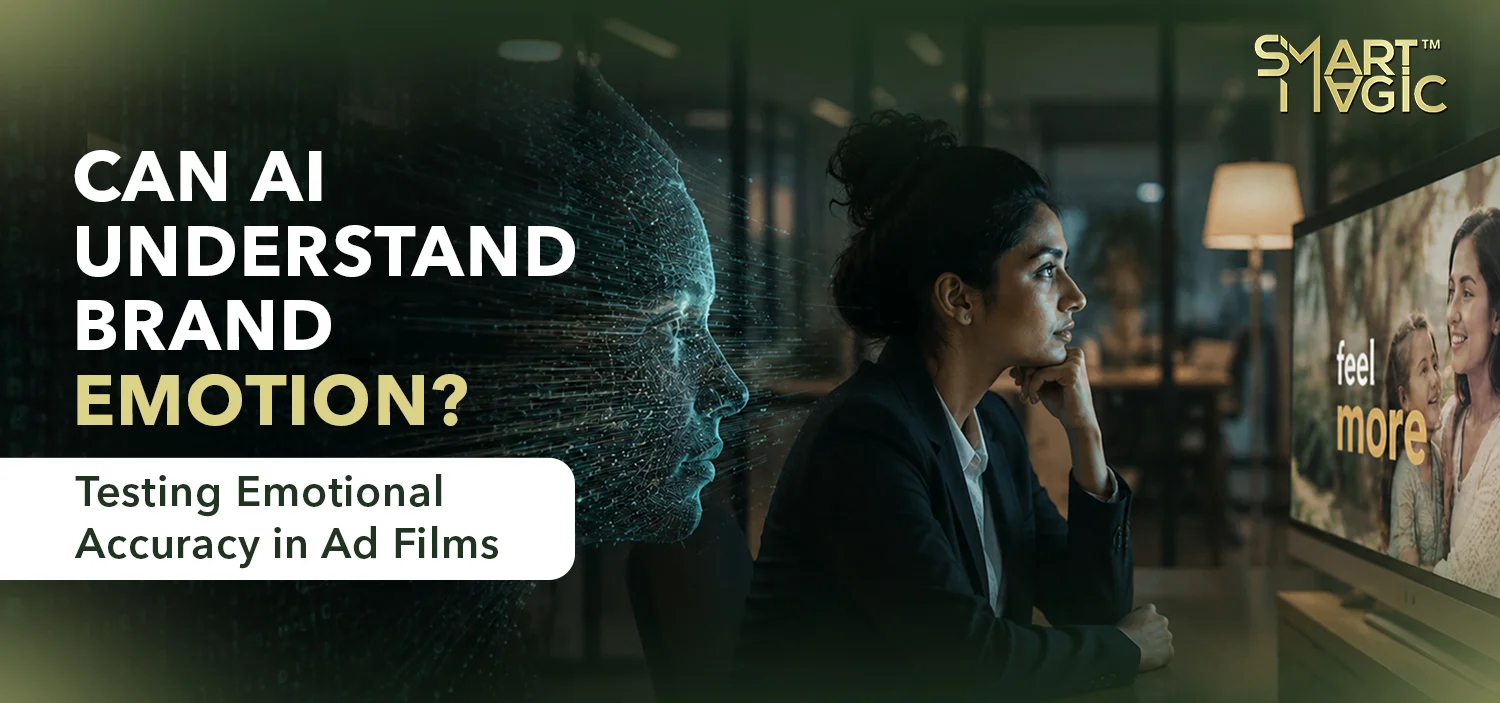
Every great advertisement leaves behind something more valuable than impressions—it leaves behind an emotion.
Some make us smile.
Some make us cry.
Some stay in our minds for years because they made us feel something.
Today, artificial intelligence is transforming advertising faster than any technology before it. AI can generate scripts in seconds, create realistic visuals, edit videos, clone voices, and even predict audience engagement.
But there’s one question every marketer, filmmaker, and brand strategist is beginning to ask:
Can AI actually understand emotion, or is it simply recreating patterns that look emotional?
As AI-generated commercials become increasingly common, brands face an important challenge—not whether AI can create ads, but whether those ads genuinely connect with people.
Let’s explore where AI succeeds, where it struggles, and what emotional storytelling truly requires.
Why Emotion Matters More Than Ever
People rarely purchase products based solely on logic.
They buy because of trust.
They remember because of emotion.
The most iconic advertising campaigns aren’t remembered because of product specifications. They’re remembered because they made audiences laugh, cry, feel hopeful, nostalgic, or inspired.
Research in consumer psychology consistently shows that emotional campaigns tend to outperform purely rational campaigns in long-term brand building because emotions create stronger memory associations and deeper customer loyalty.
An advertisement isn’t simply information.
It’s an emotional experience.
That’s exactly where AI faces its biggest challenge.
AI Doesn’t Feel Emotions—It Predicts Them
This distinction is important.
AI doesn’t experience happiness.
It doesn’t understand grief.
It doesn’t know what nostalgia feels like.
Instead, it identifies patterns from millions of existing advertisements, films, scripts, and marketing materials.
When prompted to create an emotional commercial, AI predicts what emotional content usually looks like based on previous data.
In simple terms:
- Humans create from experience.
- AI creates from probability.
Sometimes those predictions are remarkably accurate.
Other times, something subtle feels missing.
Where AI Performs Surprisingly Well
AI has become incredibly capable at producing emotionally structured content.
Today, it can:
- Generate heartfelt scripts
- Suggest emotional music
- Recommend cinematic camera angles
- Create touching voiceovers
- Match pacing with emotional intensity
- Produce visual metaphors
- Adapt advertisements for different audiences
For many informational or lifestyle advertisements, these capabilities dramatically reduce production time.
Brands can rapidly test multiple creative directions before investing in final production.
Instead of producing one version of a commercial, teams can experiment with ten.
This speed is one of AI’s biggest advantages.
The Emotional Gap AI Still Can’t Cross
Despite impressive progress, audiences often describe AI-generated emotional content with words like:
- Beautiful
- Polished
- Cinematic
But rarely:
- Authentic
- Personal
- Unforgettable
Why?
Because genuine emotion often comes from imperfections.
A pause before someone speaks.
A tear that wasn’t scripted.
A smile that happens unexpectedly.
A moment of silence.
An actor remembering something personal.
These moments aren’t generated from statistical prediction.
They’re lived experiences.
Human storytellers naturally recognize emotional nuances that AI still struggles to identify.
Emotional Accuracy vs Emotional Authenticity
There’s an important difference between these two ideas.
Emotional Accuracy
AI can correctly identify that a scene should feel:
- Happy
- Sad
- Hopeful
- Inspirational
- Romantic
It can generate scenes that visually match those emotions.
Emotional Authenticity
Authenticity asks a different question:
Does the audience actually believe the emotion?
That’s significantly harder.
Authenticity comes from context.
Relationships.
Culture.
Timing.
Personal experiences.
Life itself.
That’s where human creativity still dominates.
Brand Emotion Is Different From Human Emotion
Every brand has its own personality.
Luxury brands communicate exclusivity.
Healthcare brands communicate reassurance.
Finance brands communicate trust.
Automotive brands communicate confidence.
Food brands communicate comfort.
Understanding those emotional identities requires more than recognizing facial expressions.
It requires understanding:
- Audience psychology
- Brand history
- Cultural expectations
- Market positioning
- Consumer behaviour
AI can analyse these variables.
Creative professionals interpret them.
That difference shapes how audiences perceive a campaign.
Can AI Measure Emotional Impact?
Interestingly, AI may be better at measuring emotion than creating it.
Modern AI tools can analyse:
- Facial expressions
- Eye movement
- Voice sentiment
- Viewer attention
- Audience retention
- Engagement rates
- Click-through behaviour
- Emotional keywords in comments
These insights help marketers understand whether advertisements are connecting with audiences.
Instead of replacing creative decisions, AI becomes a feedback engine.
It tells brands what audiences responded to—not necessarily why they felt that way.
The Biggest Risk of AI-Generated Advertising
As more brands adopt AI, another problem is emerging.
Everything begins to look similar.
Many AI-generated advertisements rely on:
- Similar cinematic shots
- Similar storytelling arcs
- Similar colour grading
- Similar background music
- Similar emotional dialogue
Over time, originality decreases.
When everyone uses the same tools trained on similar datasets, creative diversity naturally shrinks.
Brands risk becoming visually interchangeable.
Standing out becomes harder.
Ironically, uniqueness becomes more valuable than ever.
The Future Isn’t Human vs AI
The smartest agencies aren’t replacing creatives with AI.
They’re combining both.
Imagine this workflow:
AI researches audience behaviour.
AI generates creative options.
AI creates storyboards.
AI suggests edits.
Human writers rewrite dialogue.
Directors reshape performances.
Cinematographers add emotional texture.
Editors refine pacing.
The result is faster production without sacrificing authenticity.
AI becomes a creative assistant—not the storyteller.
Testing AI’s Emotional Accuracy
Several creative teams have begun comparing AI-generated advertisements with traditionally produced campaigns.
Common observations include:
- AI performs exceptionally well with product explainers.
- It accelerates ideation and scripting.
- It helps create personalized campaign variations.
- It improves production efficiency.
- Human-created advertisements still perform better when emotional depth is the primary objective.
This doesn’t mean AI has failed.
It simply highlights that emotional intelligence involves more than data.
It involves lived experience.
What Brands Should Consider Before Using AI
Before relying heavily on AI-generated advertising, brands should ask:
- Does this story feel authentic?
- Does it reflect our brand values?
- Would our customers believe this moment?
- Are we creating emotion or merely imitating it?
- Does the campaign sound like everyone else’s?
These questions remain essential regardless of how advanced AI becomes.
Technology can amplify creativity.
It cannot replace purpose.
Final Thoughts
Artificial intelligence has already transformed advertising.
It creates faster workflows, improves efficiency, and opens creative possibilities that were unimaginable just a few years ago.
But emotional storytelling remains one of the most human aspects of communication.
AI can predict emotional patterns.
Humans understand emotional meaning.
The future of advertising won’t belong exclusively to AI or human creators—it will belong to brands that know how to combine both.
The most memorable campaigns will continue to use AI for speed and scale while relying on human insight to create stories that genuinely move people.
Because audiences don’t remember advertisements simply because they looked beautiful.
They remember how those advertisements made them feel.
Conclusion
As AI becomes a core part of modern advertising, brands must focus on balancing technological efficiency with authentic storytelling. AI can accelerate ideation, optimize production, and even help analyse audience emotions, but genuine brand emotion still depends on human understanding, cultural context, and creative intuition. The strongest campaigns of the future will come from creative teams that know when to let AI automate the process—and when to let human emotion lead the story.
At Smart Magic Productions, we believe AI is one of the most powerful creative tools available today—but it’s most effective when combined with human storytelling, cinematic vision, and a deep understanding of brand identity. The future isn’t about choosing AI or creativity; it’s about using both to create advertising that truly resonates.