
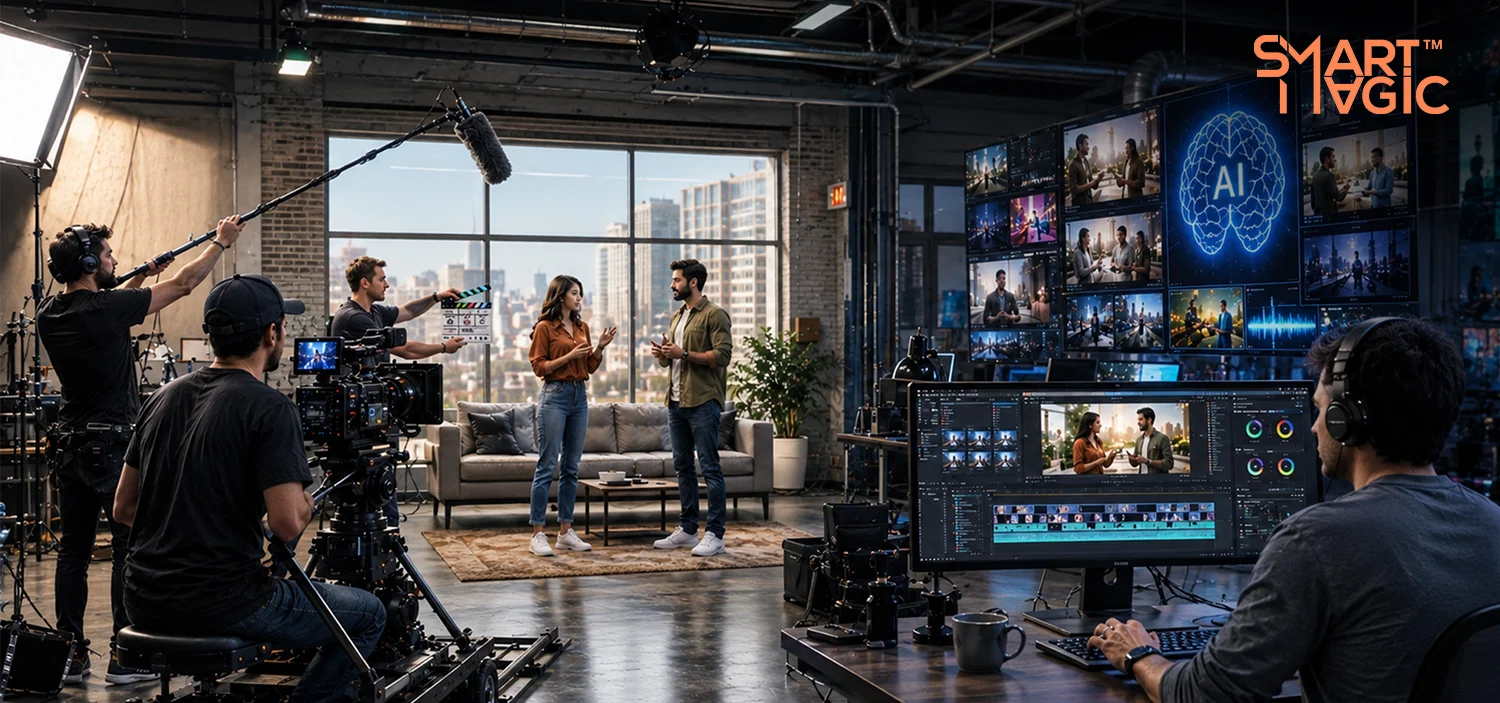
Advertising has always been a race against time. A brand starts with an idea, the creative team turns that idea into a concept, and then begins the long process of turning it into an actual advertisement. Scripts need to be written, locations need to be found, actors and production teams need to be arranged, and the shoot needs to be planned. Once filming is complete, editing, sound design, colour correction, visual effects and multiple rounds of revisions follow.
What if some of that process could happen much faster?
That is exactly where AI is beginning to make a difference. From developing ideas and creating visual references to assisting with editing and producing different versions of an advertisement, AI is becoming part of the modern advertising workflow. It is not replacing the entire production process, but it is helping creative teams spend less time on repetitive work and more time on the work that actually requires human creativity.
Why Does Ad Production Take So Long?
To understand how AI is changing advertising, it helps to first understand why traditional production takes time. Every advertisement starts with a brief, but turning that brief into something people can actually see and hear involves several stages. The creative team needs to understand the objective, develop an idea, write the script and figure out how that idea should look on screen.
Once the creative direction is approved, the production process begins. Locations are shortlisted, actors are selected, equipment is arranged and the shooting schedule is created. Even a simple advertisement can involve several people working behind the scenes to make sure everything comes together properly.
Then comes post-production. Hours of footage may need to be reviewed to find a few seconds of usable material. Editors assemble the story, sound designers work on audio, music is added, graphics are created and the colour is corrected. The client then reviews the video, provides feedback and the team goes through another round of changes.
This is why a short advertisement can sometimes take weeks to move from a simple brief to a finished video.
AI is now helping shorten several of these stages.
AI Is Entering the Process From the Very Beginning
One of the biggest changes is that AI is not only being used after filming is complete. It is becoming useful much earlier in the creative process.
Imagine a brand wants to create an advertisement for a new product. The creative team may have several possible ideas but traditionally needs time to develop each one, write different versions and create references before deciding which direction is worth pursuing.
AI can speed up this exploration.
Creative teams can use AI to develop initial ideas, explore different story directions, create script variations and generate visual references. Instead of spending hours developing every possibility manually, teams can quickly explore several directions and then focus their energy on the strongest ones.
The important part is that AI does not have to make the creative decision. It can simply help the team reach that decision faster.
From a Written Idea to a Visual Reference
One of the most useful applications of AI in advertising is turning an idea into something visual.
A creative director might have a particular scene in mind but find it difficult to explain exactly how it should look. In the past, the team might have needed an illustrator, photographer or designer to create references before everyone could properly understand the idea.
AI can now help create those early visual references much faster.
These visuals do not necessarily become the final advertisement. Instead, they can act as a starting point for conversations between the creative team, client and production crew. Everyone can look at the same visual direction and discuss what works, what does not and what needs to change.
This can save a surprising amount of time before the cameras even start rolling.
AI Can Make Pre-Production More Efficient
Pre-production is often where a lot of planning happens. Scripts need to be finalised, shots need to be planned, locations need to be considered and the production team needs to understand exactly what needs to be captured.
AI can assist with many of these tasks.
For example, a creative team can use AI to explore different versions of a script, shorten a script to fit a specific duration or develop possible shot ideas. It can also help create early storyboards and visual references that give the production team a clearer understanding of the final direction.
Better preparation can make the actual shoot more efficient. When everyone knows what needs to be captured before arriving on set, there is less time spent figuring things out during production.
The shoot still happens, but the process around it becomes more organised.
The Production Process Can Become More Flexible
AI is also beginning to influence what happens during production itself. Technologies such as virtual production and AI-assisted visualisation can help teams understand how certain scenes might look before they commit significant time and money to them.
For larger advertisements, this can be particularly useful. A production team can experiment with environments, visual styles and certain creative possibilities before making final production decisions.
This does not mean that real shoots are disappearing.
Actors still need to perform. Directors still need to direct. Cinematographers still need to light and shoot scenes. What changes is how much preparation can happen before those people step onto the set.
Post-Production Is Where AI Can Save Significant Time
Once filming is finished, the editing process begins. This is another area where AI is becoming increasingly useful.
Modern editing tools can assist with tasks such as transcribing dialogue, creating captions, finding specific moments in large amounts of footage and removing certain unwanted elements. These tasks may seem small individually, but they can take up a significant amount of an editor’s working day.
Consider a shoot where several hours of footage were recorded for a 30-second advertisement. An editor still needs to go through that footage and find the best performances, shots and moments.
AI can help organise and search through that material faster.
This allows editors to spend more of their time on creative decisions such as pacing, storytelling, emotion and performance. Those are the parts of editing where human judgement makes a major difference.
Creating Multiple Versions Is Becoming Easier
Advertising today is rarely created for just one platform.
A campaign might require a 60-second film for YouTube, a 30-second version for social media, shorter videos for Instagram Reels, vertical versions for mobile screens and several different variations for different audiences. Creating every version manually can add considerable time to the production process.
AI-assisted tools can make these adaptations faster.
Instead of rebuilding every version from the beginning, teams can work from the original content and make changes according to the platform, duration or audience. Captions, aspect ratios, cuts and other adaptations can be handled more efficiently.
For brands running large digital campaigns, this can make a major difference. The same creative idea can be adapted into more formats without requiring the entire production process to start again.
Faster Production Does Not Mean Less Creativity
There is a common concern that AI could make advertising feel repetitive or generic. If everyone uses AI in exactly the same way, there is certainly a possibility that some content could start looking similar.
But speed is not the only advantage AI brings to advertising.
When repetitive tasks become faster, creative teams get more time to think. They can test more ideas, explore different visual directions and experiment with alternative scripts without spending the same amount of time on each version.
This can actually create more room for creativity.
Instead of spending hours on tasks that could be assisted by technology, creative professionals can focus on the bigger questions. Does the idea make people stop scrolling? Does the story make sense? Does the advertisement feel right for the brand? Does it connect with the audience?
Those questions still require human thinking.
Human Creativity Still Has the Final Say
Advertising is ultimately about people. It is about understanding what makes an audience pay attention, what emotions they respond to and what kind of story feels relevant to them.
AI can generate ideas and assist with execution, but it does not automatically understand the cultural context, emotion or personality behind a brand.
A tool might create ten different concepts, but someone still needs to decide which one is worth developing. AI can suggest a script, but a writer needs to know whether the dialogue actually sounds natural. An editing tool can identify useful footage, but an editor needs to understand when a scene should move quickly and when it needs time to breathe.
That is why the future of advertising is unlikely to be completely automated.
It is more likely to be AI-assisted.
The New Ad Production Timeline
The traditional advertising process can often be described as:
Brief → Concept → Script → Pre-Production → Shoot → Edit → Revisions → Final Advertisement
AI is beginning to compress several of these stages.
A modern workflow may look more like:
Brief → AI-Assisted Ideation → Creative Development → Production → AI-Assisted Post-Production → Multiple Versions → Final Delivery
The difference is not simply that there are fewer steps. The bigger change is that some of these steps can happen much faster, while certain tasks can happen alongside each other.
A creative team can develop ideas while creating visual references. An editor can use AI to organise footage while working on the first cut. Different versions of an advertisement can be prepared without rebuilding everything from scratch.
The production timeline becomes shorter and, more importantly, more flexible.
A Shorter Timeline Can Lead to Better Advertising
One of the biggest advantages of faster production is not simply saving money or finishing a project sooner. It is the ability to experiment more.
In traditional advertising, trying a completely new creative idea can be expensive. A new concept may require another shoot, another location, additional production resources and more time.
When certain parts of the creative process become faster, teams can explore more possibilities before committing to the final idea.
That changes the conversation.
Instead of immediately asking, “How much will it cost to try this?” creative teams can spend more time asking, “Is this idea worth trying?”
That shift could lead to better campaigns because more ideas get a chance to be explored.
AI Will Not Make Advertising Instant
It is easy to assume that AI will eventually make the entire advertising process instant. In reality, production will continue to require time, planning and people.
Actors need to perform. Directors need to make creative decisions. Camera teams need to capture footage. Editors need to shape the story. Clients need to review the work and make sure the final advertisement represents their brand correctly.
AI also has limitations. Generated content can contain mistakes, visual consistency can be difficult to maintain and AI-generated ideas still need human review. For professional advertising, accuracy, brand consistency and creative quality remain extremely important.
The goal, therefore, should not be to remove people from the process.
The goal should be to remove unnecessary delays.
From Brief to Final Cut, Faster
The biggest change AI may bring to advertising is not the disappearance of creative professionals. It is the reduction of waiting time between different stages of production.
Waiting for a concept to be developed. Waiting for visual references. Spending hours searching through footage. Recreating the same content for different platforms. Making repetitive post-production changes.
When these tasks become faster, creative teams can focus on the parts of advertising that matter most.
They can think more. Experiment more. Create more.
The journey from a creative brief to a final advertisement is becoming shorter, but speed should not be the only goal. The real opportunity is to use that saved time to create stronger ideas, better stories and more relevant campaigns.
AI can help make advertising production faster.
What humans do with that extra time will determine whether it also makes advertising better.