
The Advertising Production Process Is Changing
For decades, advertising production has followed a fairly familiar process. A brand develops an idea, a production company turns that idea into a script, locations are selected, actors and crew are booked, equipment is arranged and the shoot finally takes place. Once filming is complete, the footage moves into editing, visual effects, colour grading and other post-production stages before the advertisement is ready to launch.
That process is still very much alive. However, the amount of work that needs to happen physically on a shoot is beginning to change. Artificial intelligence, virtual production, digital environments and advanced post-production tools are allowing production teams to move some creative work away from the physical set.
This is creating an interesting shift in the advertising industry. The future is not necessarily about eliminating traditional shoots. It is about making each shoot more purposeful and using technology to expand what can be achieved around the footage that is captured.
In practical terms, this could mean fewer shoot days, smaller physical setups and more creative possibilities from the same production.
Why Brands Are Looking for More Efficient Production
Advertising production can become expensive very quickly. A single shoot involves much more than cameras and actors. There are locations, equipment, lighting, set design, transport, accommodation, production crew, talent, props and a long list of logistical requirements.
Every additional scene can add another layer of complexity. If a campaign requires several locations, multiple environments or different versions of the same advertisement, production requirements can increase significantly.
This is particularly challenging for brands operating in the digital advertising space. Social media and performance marketing have created a constant demand for new creative. Brands may need several versions of an advertisement for different audiences, platforms, formats and campaign objectives.
Producing every one of those variations through a completely separate physical shoot is difficult to sustain. This is where new production technologies are becoming valuable.
Technology Is Changing What Needs to Be Captured on Camera
One of the biggest changes taking place is the separation between what needs to be filmed and what can be created digitally.
In a traditional production, a director may need to find or build the exact environment required for a scene. Today, certain environments can be created digitally or enhanced after filming. A product can be photographed in a controlled studio and later placed into different environments. A performer can be filmed against a controlled setup and integrated into a digitally created world.
This does not make the camera less important. Instead, it allows production teams to think more carefully about what the camera actually needs to capture.
If an environment can be created more effectively in post-production, there may be little reason to spend an entire day physically constructing it. At the same time, if a real location or practical set adds authenticity to the story, capturing it traditionally may still be the better option.
The production process therefore becomes a combination of physical and digital decisions.
AI Is Making Creative Experimentation Faster
Artificial intelligence is adding another layer to this transformation. One of its biggest advantages in advertising production is the ability to help teams explore visual ideas quickly.
Traditionally, a creative concept has to be developed before production begins. Once a location is booked and a set is built, changing the idea can be expensive. As a result, brands and production teams often have to make important creative decisions before they have actually seen the final visual.
AI-assisted tools can help reduce this uncertainty.
Creative teams can use AI to explore different environments, compositions, moods and visual treatments before committing to a physical production. These concepts can help directors and clients understand how an advertisement could look before the shoot takes place.
This does not mean that every AI-generated concept becomes the final advertisement. Its value is often in the experimentation stage. It gives teams more room to ask, “What if?” before production begins.
Fewer Shoot Days Can Create More Creative Freedom
At first, the idea of fewer shoot days may sound like a purely financial benefit. Fewer days can mean lower location costs, fewer crew requirements and reduced logistical expenses.
But the creative benefit may be even more significant.
When a production team can capture the essential elements of a campaign in a shorter period, more of the budget and time can be used for experimentation and post-production. Instead of spending resources physically creating every possible version of an advertisement, teams can explore different variations digitally.
This becomes especially valuable when a brand wants to test multiple creative ideas.
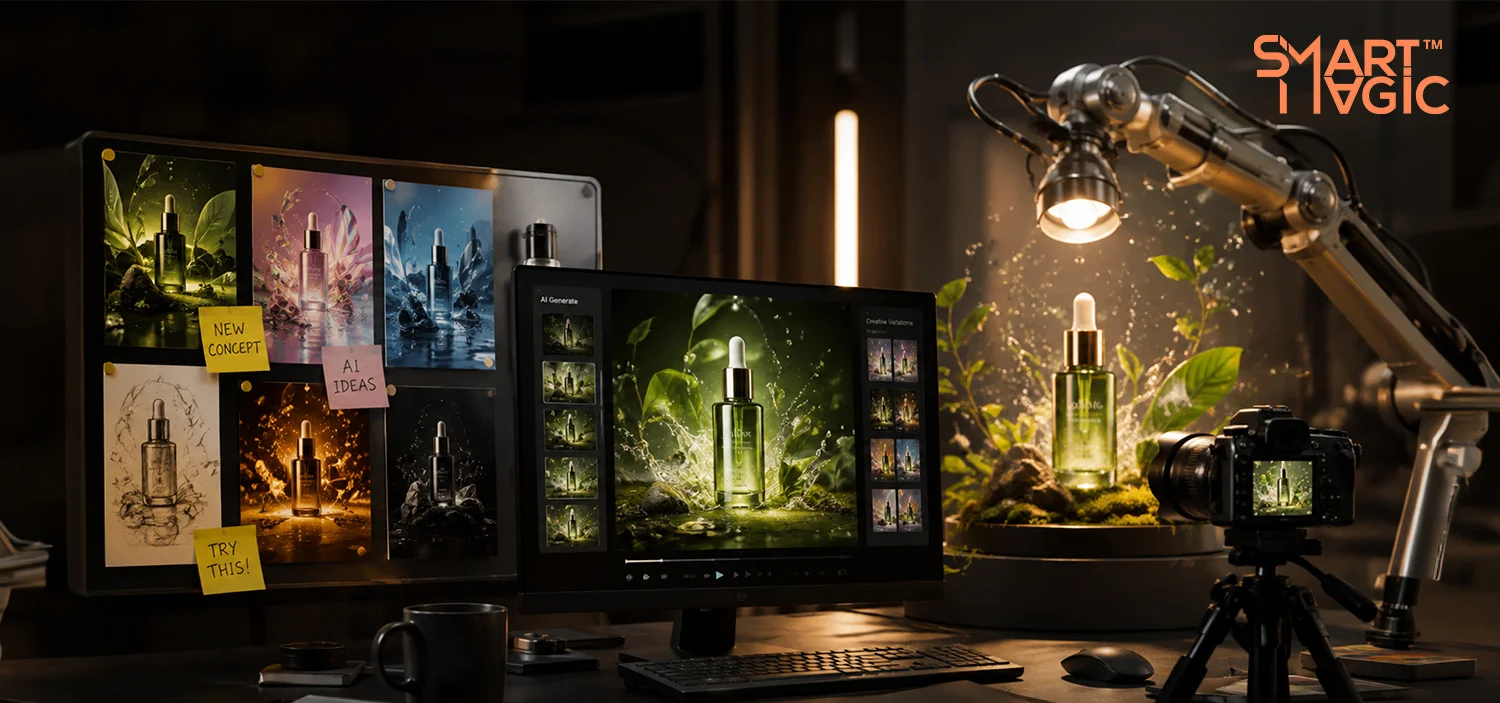
For example, a skincare brand may want to explore a luxury visual, a natural visual and a clinical visual for the same product. Traditionally, these could require separate setups or even separate shoots. With an AI-assisted workflow, the product can be captured accurately once, while different creative environments can be explored later.
The result is not necessarily less creativity. It can actually create more room for it.
Product Advertising Is Already Moving in This Direction
Product advertising is one of the areas where these changes are particularly visible.
A product can be photographed in a controlled studio environment with careful attention to packaging, lighting and detail. Once the core product asset has been created, digital tools can be used to explore different backgrounds and campaign environments.
A perfume bottle could be presented in a luxury setting for one campaign and a darker, cinematic environment for another. A food product could be placed into a lifestyle setting without requiring the entire environment to be physically constructed. A technology product could be presented in a futuristic digital environment that would be difficult or expensive to build physically.
The important point is that the product itself still needs to be represented accurately. AI can help create the world around the product, but brands need to ensure that packaging, logos, colours and other identifying details remain correct.
This is why human supervision remains an important part of AI-assisted production.
Virtual Production Is Expanding What Advertisements Can Look Like
Virtual production is also changing the possibilities available to advertisers. Instead of relying entirely on physical locations or traditional sets, production teams can use digital environments to create specific worlds around live-action footage.
This can be useful when a campaign requires a location that is expensive, inaccessible or simply impossible to find. A brand could potentially create an environment that matches the creative idea without physically travelling to that location.
The technology also gives directors greater flexibility during the creative process. Digital environments can be adjusted, expanded or replaced without necessarily requiring the entire production to start again.
However, virtual production is not a replacement for real locations. Physical environments still offer details, textures and natural interactions that can be difficult to reproduce digitally. The advantage comes from having another option available when deciding how a particular scene should be created.
One Shoot Can Produce More Content
Another important change is the move towards creating more assets from a single production.
Traditionally, a shoot might be planned around one television commercial or one hero video. Today, brands often need much more. The same campaign may require a main film, short social media edits, vertical videos, product visuals, digital banners and multiple versions for different audiences.
This makes the idea of modular production increasingly important.
Instead of treating the shoot as the production of one final advertisement, teams can capture a collection of useful assets. These could include product shots, performances, different camera angles, voiceovers and supporting footage.
Digital tools can then be used to create multiple outputs from those assets.
This approach allows a single production to support a much larger content ecosystem.
Advertising Is Becoming More Adaptable
One of the biggest advantages of this new production model is adaptability.
Traditional advertising campaigns are often designed around a fixed final film. Once the advertisement is completed, changing the creative direction can be difficult.
Digital production allows certain campaign elements to remain flexible for longer.
A brand may decide that one visual works better for Instagram while another works better for a display campaign. A particular audience may respond better to a different message or environment. Instead of returning to production for every adjustment, some changes can be made through digital workflows.
This is particularly relevant to performance marketing, where brands increasingly rely on creative testing to understand what resonates with their audiences.
The Role of Pre-Production Will Become Even More Important
It may seem strange, but fewer shoot days could actually make pre-production more important.
When production becomes more flexible, there are more creative possibilities to consider. Teams need to understand which elements should be captured physically and which can be developed digitally.
AI-generated concept frames, storyboards and visual references can help answer these questions before the shoot begins. Directors can explore different approaches, clients can review possible visual directions and production teams can identify technical challenges earlier.
This means that the shoot itself can become more focused.
Rather than using production time to figure things out on the day, teams can arrive with a much clearer understanding of what they need to capture.
That can make the actual shoot more efficient without compromising the creative ambition of the project.
Human Creativity Still Drives the Campaign
With all the attention around AI and new production technologies, it is easy to assume that technology will eventually become the main creative force behind advertising.
That is unlikely to happen.
AI can generate visual possibilities, but it does not automatically know which idea is right for a particular brand. It can create hundreds of images, but that does not mean those images communicate anything meaningful.
A successful advertisement still needs a strong concept, a clear message and an understanding of its audience.
The creative team decides what the advertisement should say. The director decides how that idea should come to life. The production team determines how to capture it. Technology simply gives these teams more ways to execute the idea.
In that sense, the future of advertising production is not less human. It may actually require more creative judgement because teams will have more possibilities to choose from.
Production Teams Will Need to Become More Hybrid
As the production process evolves, the people working within it will also need to adapt.
Traditional production skills will remain important, but professionals may increasingly need to understand AI tools, virtual production, 3D environments, compositing and digital workflows.
A producer may need to decide whether a particular scene should be filmed on location or created digitally. A director may need to understand how a digitally generated environment will interact with a live performer. An editor may work with both traditionally captured footage and AI-assisted elements.
This does not mean everyone needs to become an AI specialist.
It means production teams will increasingly benefit from understanding what different technologies can and cannot do.
The Future Is Not Fully Digital
Despite the rapid development of AI, there is little reason to believe traditional advertising shoots will disappear.
There will always be situations where real people, real locations and physical environments create something that digital production cannot completely replace.
A genuine performance has a certain quality. A real location has natural imperfections. Practical lighting and physical objects interact in ways that can be difficult to reproduce perfectly.
The future is therefore more likely to be hybrid than completely digital.
Some elements will be captured physically. Others will be created digitally. The production team will decide which approach works best for each part of the advertisement.
What This Means for Brands
For brands, the biggest change may be the ability to think beyond the traditional idea of a “shoot.”
A production no longer has to be viewed only as a few days during which the final advertisement is filmed. It can become the beginning of a larger creative system.
The brand can capture core assets during the physical production and then continue developing variations through AI, virtual production and post-production.
This can help brands produce more content, test more creative directions and adapt campaigns for different platforms without constantly returning to the physical production stage.
It also gives smaller brands an opportunity to explore ideas that may previously have required larger production budgets.
The Future of Advertising Production Is About Doing More With Less
The biggest change coming to advertising production is not simply that brands will shoot fewer days.
It is that production teams will become more strategic about what they choose to shoot.
A physical shoot will focus on the elements that benefit most from being captured in the real world. AI and digital production can then be used to expand those assets, create variations and build environments that would otherwise require additional production.
This creates an interesting balance between efficiency and creativity.
Brands can potentially spend less time dealing with physical production constraints while giving creative teams more freedom to explore ideas.
The goal is not to replace the production process with technology. It is to remove unnecessary limitations from the production process.
Conclusion
The future of advertising production is likely to be a blend of traditional filmmaking and emerging technology. AI, virtual production and advanced post-production are making it possible to rethink how advertisements are planned, filmed and delivered.
Fewer shoot days do not necessarily mean fewer creative possibilities. In many cases, they could mean the opposite.
When brands can capture the essential elements of a campaign and then build, adapt and experiment digitally, one production can generate far more creative possibilities than before.
The camera will continue to play an important role in advertising. But as production technology evolves, the question will increasingly become not “What do we need to shoot?”, but “What is the smartest way to create this idea?”
That shift could define the next generation of advertising production.
Read More: AI-Generated Product Ads: How Brands Can Turn Simple Product Shots Into Campaign-Ready Visuals